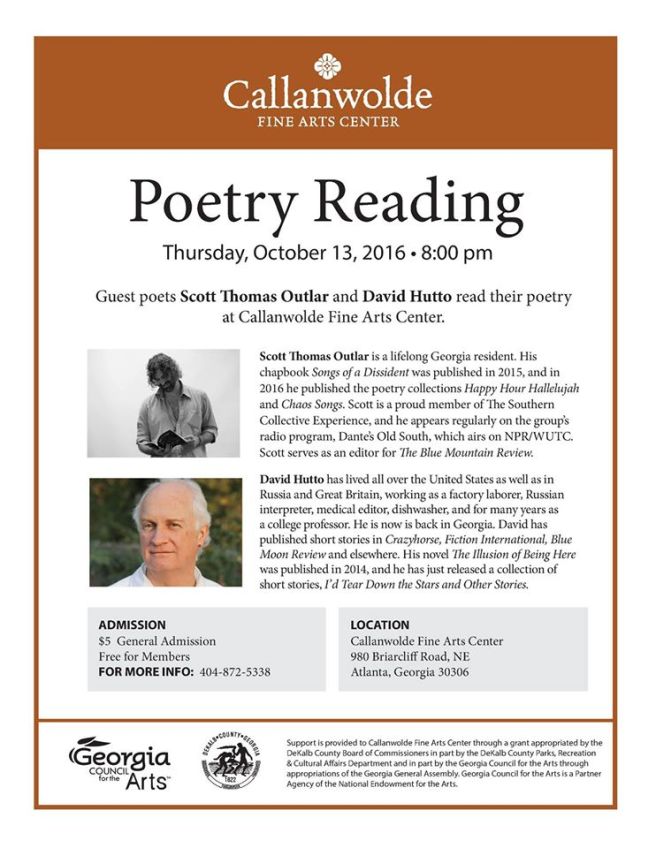
This is an interview that originally appeared at Yellow Chair Review in September of 2015. The questions were posed to me by Alexzan Burton. After noticing that it is no longer available at that site, I decided to post it here for posterity. I am tempted to do a complete overhaul on the transcript because some of the information is outdated, but in the interest of keeping the original integrity of what was going on at the time, I’ll leave things as they first appeared. For the most part. A few minor edits have been made where I felt it to be absolutely necessary.
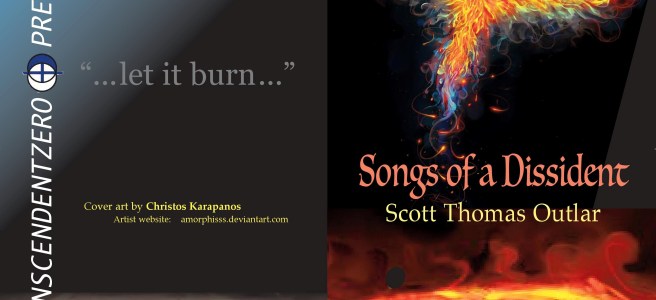
My book, Songs of a Dissident, is mentioned at one point as being in the works. It has since been published through Transcendent Zero Press. Two other books have also been released recently. Further information about each title can be found here.
Alexzan Burton: When did you start writing? What prompted you to do so?
Scott Thomas Outlar: I recall having written a few short stories based around Nintendo characters, as well as some rather silly song lyrics, back when I was in elementary school, so I suppose the initial seed was always there from an early age. It wasn’t until years later, after graduating from high school, that I began writing again. At that time it was mostly journal entries and bad, abstract lyrics…basically a way to flush out many years of angst and depression onto paper. I continued in this vein for a few years, filling up notebooks with what I now would refer to as being absolute gibberish. It was in 2003 that I realized I wanted to start writing books. That is the moment when I really began dedicating myself to the craft. It took several more years before I began writing anything decent…a few short stories here and there. I always knew that I wanted to eventually publish, but I was going to make sure that I was completely confident in my work and ready to put 100% effort toward the process before I took the dive and began submitting.
AB: What is it that inspires your writing?
STO: Inspiration can come from just about anywhere for me. I might wake up with an image from a dream rolling around in my head and write about that. Music, of course, is always a driver of creativity. I might be reading another poet’s work when some word or phrase they use could trigger my mind off on a tangent that turns into a poem of my own. Nature inspires me. The search for truth inspires me. The madness of this American society inspires me. Spirituality, literature, philosophy, psychology, politics, science…there really is no end to the well of possible inspiration (thank God).
More specifically, when I look over some of the pieces that have appeared in Yellow Chair Review, I would say this about “To the Fascist Fundamentalist Editor”: the basic inspiration this poem sprang out of was not necessarily based on any actual experience I’ve had, but more from the general idea that some people have about what a “real” poem should be. It is a response to different schools of thought based on form and structure that might have a tendency to look down on free verse or abstract poetry. Personally, I find that there is a place for all forms of art, be it poetry, music, painting, or whatever else. So I tend not to get hung up on how a “proper” poem should be presented. All that being said, I also enjoy being purposefully provocative and writing things that I know will get a rise out of some people. So this poem was written from a sarcastic bent, with tongue placed firmly in cheek. One of the mottoes I often use when it comes to my words is that my writing should always be taken with at least two and one-quarter grains of salt. A glass of wine and a smoke aren’t a bad idea, either.
There is never a lack of inspiration to draw from when it comes to the decadence and corruption in this world. I don’t make any secret about the fact that I’m an anarchist at heart, and I have a rebellious streak in my soul that runs about six miles deep, so I am constantly breathing fire with a loaded tongue against the institutions of government, public education, the military industrial complex, Big Oil, Big Pharma, what I refer to as the medical industrial death machine, some of the more fringe aspects of dogmatic religion, the Federal Reserve, revolving door bureaucratic cronies, and fascism in all its myriad shapes, sizes, fashions, and forms. I tackle these topics in much of my work, but where they are examined most closely is at Dissident Voice. My archive at this social justice newsletter probably contains around 80 essays and poems at this point. The editor there, Angie Tibbs, was the first person to ever accept one of my poems just over a year ago, and I’ve been publishing a weekly piece at the Sunday Poetry Page ever since.
Some of my darker, metaphorical, abstract poetry can be found at Stephen Jarrell Williams’ blog, Dead Snakes. Stephen is another editor who has been very good to me during the past year, and I’ve been publishing fairly regularly at his site since last November. Prelude to a Reunion is a poem that was published there in January…it was inspired by the existential nature of the yawning grave which awaits us all at some point, as well as, on a more personal note, emotions I was dealing with concerning my Father’s passing last year.
I would be remiss to not also mention Guy Farmer at this point. He has been publishing my work for nearly a year now at three of his sites: The Poet Community, Poems and Poetry, and Social Justice Poetry. These venues are where some of my softer, simpler, more mild-mannered verse can be found, inspired by nature, love, and other romantic flowery ideas such as these.
This is where a problem arises as I read over what I’ve written so far. There are quite a number of editors and publications that have been kind to me and my work during this journey that I’ve begun, so I feel the urge to just start stringing a list together, wanting to thank them all. I know that isn’t practical, and so just let me say that I am very thankful to everyone who has published my words. I have an intense passion for the indie lit scene, and it is my full intention to continue doing all that I can to promote the venues that I believe in. So if I didn’t mention you here, I apologize, but just know that I have much love for you.
AB: Is your work mostly inspired by your own experiences or are there writers/artists that inspire you as well?
STO: I go through phases where I’ll write autobiographical pieces, but I look at my work primarily as being a reflection of what is going on in society and around the world. There are basic conditions and emotions that we all share as humans, so I try and draw on those as the general core of what I work outward from.
When it comes to other writers and artists that I’m inspired by, the list is long. Some of the most influential and inspirational to me have been Hunter S. Thompson, Henry Miller, Jack Kerouac, Charles Bukowski, Hermann Hesse, Friedrich Nietzsche, Roger Zelazny, Robert Silverberg, Joseph Campbell, Thich Nhat Hanh, Marcus Aurelius, Kurt Cobain, Eddie Vedder, Maynard James Keenan, Daniel Johns, and on and on…
The truth of the matter is that during the past year since I started publishing poetry, I have been reading almost exclusively the work of other contemporary poets. There are so many good writers out there that I’m almost afraid to start another list out of fear I’ll leave someone out…but, what the hell, eh? Just a few are: Irsa Ruci, Charles Clifford Brooks III, Heath Brougher, Strider Marcus Jones, Sheikha A., Don Beukes, Adam Levon Brown, Sudeep Adhikari, Laura M. Kaminski, Phillip Matthew Roberts, Sarah Frances Moran, Nana Arhin Tsiwah, Ajise Vincent, Ananya S. Guha, and Alan Britt. That’s fifteen of probably a hundred who I could say inspire me regularly with the quality of work they put out. Ye gods! There really are so many more I could list. The indie lit scene is in the beginning of a new Renaissance. I’m going to just put that on the record right now. There is a rising tide, and I’ll be right up front and honest about the fact that I want to be a drop of water in that high wave when it peaks.
Are you currently working on anything that we get to look forward to? Any little hints for us?
I have a contract for my chapbook Songs of a Dissident that I should be signing very soon. I can’t give an exact timetable on when it will be released, but hopefully it should be coming out in the not too distant future. I’ve also had some initial conversations with Scott Wozniak about putting out a collaborative book through his Flying Wrench Press. We both have a bit of a revolutionary bent to our styles, so if it should happen to develop I think it’ll be rather inflammatory when all is said and done.
However, I’m still fairly new on the scene at this point, so what I try to focus on mainly is making solid connections with editors and publications in an effort to build a foundation for potential future projects. I’m still constantly sending out submissions, trying to get my feet wet in as many venues as possible. I also keep my blog 17numa.wordpress.com updated on a regular basis with new poetry and links to any published work that comes out. Anyone interested in connecting with me can do so at the blog, as well as on Facebook and Twitter where I’m also fairly active.
Do you have words of wisdom for writers who are stuck in that period of rejection that seems to last forever? The acceptance letter is always a ray of sunshine after a dry spell. haha.
If there is one thing I’ve learned so far as a published poet it is that there is only one thing in life that never gets old, and that is receiving an acceptance letter in your email’s inbox. Now don’t get me wrong, good conversation, gluttonous feasting, and trips to the beach are always pretty epic too, but speaking on a strictly professional level, nothing beats the acceptance letter.
But, of course, with the good there is also the bad. Thus we come to the question of the rejection notice – that villainous form letter that plagues us all from time to time (sometimes more often than others). What I would say about being rejected is, first off, it’s going to happen. A lot. It’s a catch-22 in some ways, because the more courage you have in sending out your work, the more you’re going to get rejected. Hell, there is a chance it might happen to me as I type this very sentence (though that would be a cruel twist of fate, indeed). The main thing about being rejected is to always remember that writing, especially poetry, is an incredibly subjective field. Every editor and publisher is going to have their own personal likes and dislikes, pet peeves, soft spots, and opinions on what they are looking for. The context is almost infinite when it comes to what journals are seeking. Some venues may prefer shorter pieces, while others prefer longer. Some magazines might prefer personal anecdotes, while others dig metaphorical, abstract, meandering pieces full of allusions and wild surrealist imagery. That is why it’s important to research the markets that you’re sending work to. Read the different publications to get a feel for what type of style and aesthetic they are generally drawn toward, and then concentrate your efforts on those spots that you feel your work best vibes and syncs with. Even then, you’re still going to get rejected, but try not to let it get you dejected. If you believe in your work and know it to be good, then I assure you that there is somewhere out there that’ll accept it. Remember also that editors are human just like you are; they have good days, bad days, happy days, sad days, and all the days in between. We all try to be objective in life, but let’s face it, sometimes our mood affects our decisions. So if you submitted a piece full of fire, brimstone, and apocalyptic fire, and the editor that is reading it can’t stop thinking about how in love they are with their new significant other, well, tough luck, you’re probably not going to get an acceptance this time around, Bubba. But if that editor recently went through a bad break up and has a heart full of black coal at the moment, well, ding, ding, ding, your chances with said piece are probably increased. That is just one rather crude example meant to drive home the point that it all comes down to context. The bottom line, after all is said and done, is persistence. If you have the drive to be successful and you are willing to keep sending your work out into the ethereal realms of submission land, you’ll come out alright in the end.
And writer’s block! Do you ever suffer from writer’s block? Do you have any secrets for combating the dreaded wall?
I have to say that I’ve been fortunate for quite a while now in being able to put out work consistently. The main reason for this, I think, has to do with the fact that I try my best to accept whatever type of mood or mindset I’m in at any given time. So whether I’m feeling happiness, sadness, jubilation, depression, melancholy, confusion, fear, spiritual ecstasy, existential dread, or whatever other emotion, I don’t fight against it, but instead use it as a propellant in the artistic process.
One trick that I might throw out there is to find different poetry prompt challenges and let your inspiration start from a place outside your own consciousness. Sometimes a random word, line, color, design, or picture can spur something down in the depths of your bowels that triggers the release of ink you’re seeking. Another suggestion when you find yourself in the rut of not being able to write is to try and write about not being able to write. Turn the energy back upon itself in a type of implosive jujitsu maneuver in which you shift the very force of writer’s block into a force of creative inspiration. If all else fails, throw the pen down, take your shoes off, step outside in the sun, and take a walk out in nature…forget about your work for a little while. Reconnect with the holy flow by just having a bit of playtime…before you realize it, you just might receive a little spark of something-something that flashes across the neuron synapses of your brain as the next big idea coming into form…





 About the Author


 17Numa