
Johnny Longfellow has served for twenty years as a mentor to Newburyport, MA high school students through the Poetry Soup reading series. A past feature at The Newburyport Literary Festival, he has also performed his work at Powow River Poets and Poetry Society of New Hampshire sponsored readings. A forthcoming feature at The Robert Frost Farm, held under the auspices of The Hyla Brook Poets, is slated for September 8, 2016. The editor of the online mixed-media site, BAD ACID LABORATORIES, INC., you can read more of his own published poetry online by visiting his link farm at Heeeeeere’s Johnny . . . Longfellow, That Is.
Scott Thomas Outlar: I appreciate you taking some of your time to join me here, Johnny. It’s a pleasure to have the opportunity to toss some questions your way. You’ve established what I consider to be two of the coolest poetry/art sites on all the interwebs, and I’d like to start off by asking about your latest project: BAD ACID LABORATORIES, INC. What prompted you to launch this venue? What type of vibe were you seeking to create? How do you feel about the process so far with the first few issues now being available for the public to peruse?
Johnny Longfellow: Hi Scott, and thanks back at ya’ for asking me to do this interview. I very much appreciate the opportunity. Thanks also for the compliment on my two sites.
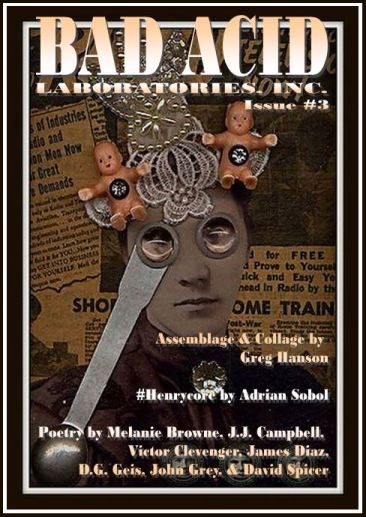
What prompted me to launch BAD ACID LABORATORIES, INC., huh? Ultimately, I wanted to take some of what I’ve learned at Midnight Lane Boutique, especially in terms of aesthetic development, and apply it to a site that was broader in terms of the themes, subjects, and artistic disciplines published. I’ve published three issues thus far, and it’s my hope to have Issue #4 out in October.
With the boutique, the overall vibe is more or less static. By that, I mean I can move the furniture around, swap elements in and out–e.g. the header, background, sidebar widgets–whatever. But, it’s constrained by the publishing model—i.e. rolling basis—not to mention it’s much more thematically limited.
Conversely, at the laboratories I’m publishing on an issue-to-issue basis, wherein the vibe is less fixed. It’s the nature of the beast, I think. Creating the vibe there is even more inextricably linked with the poetry, art, and music included on site. It’s much more an organic process, with a greater element of surprise for me in terms of piecing things together/guiding the overall movement. That noted, I ultimately hope visitors to the site have a good bad trip, and/or experience something pleasantly unpleasant. And that, very broadly speaking, is the vibe I’m striving to create.
In terms of process, I’ve enjoyed that immensely! Crafting the first three issues has been a wonderful aesthetic experience each time. For each issue published thus far, I’ve reviewed and selected poetry with an eye on how pieces worked with one another. I’ve wanted to have at least something—and I underscore something— of a cohesive feel for each issue, wherein poems have served as foundational building blocks for making that happen. Once I’ve made the cut in terms of verse, the next step has been to seek out a visual artist whose work is capable of tying a given issue together visually on a holistic level, while simultaneously complimenting individual poems. Also, I’ve thus far sought to include a little bit of music/video in each issue, to help round out the Gestalt. I’ll just add, music/video has sometimes served to fill in gaps, where honestly, it’s been difficult to match certain, selected poems with a given visual artist’s portfolio. Thus, music/video has performed double-duty in a manner distinct from the dual functions served by the visual art used.
STO: Yeah, I’ve found that the style of music you toss into the mix really helps catapult the kinetic energy to another level. It adds a unique flavor; and, of course, any trip of this nature should always be accompanied by soul-stirring tunes. Now that you’ve had a chance to settle in with the first three issues being published, do you have a stronger sense of what you’re seeking from artists and writers who submit work to the site? I understand that your themes shift between issues, but are there some general guidelines folks should follow when sending material your way? In this vein, what are the similarities and differences that should be kept in mind between Midnight Lane Boutique and BAD ACID LABORATORIES INC.?
JL: In the submission guidelines, I open by telling poets that BAD ACID LABORATORIES, INC. “seeks to publish well-crafted poetry that fits the site’s vibe, be it dark, psychedelic, gritty, confessional, esoteric, occult . . . whatever ya’ think. All styles, from free-verse, syllabic, to formal will be considered.” After outlining bureaucratic matters regarding batch size, how to submit, rights, etc., I conclude with a qualifier that poems “about bad trips, literally speaking . . . generally not preferred. But, poems on bad trips, proverbially speaking . . . those are different matters entirely. And, of interest.” Basically, I try to broadly sketch what I’m seeking, briefly note what I’m not seeking, and then just allow serendipity to do its thing. Once I’ve made the cut in terms of verse, I then seek out and solicit a visual artist whose work will compliment the poetry selected. That’s to say, unlike the poetry on site, all the art is solicited.
That’s all more or less in contrast to the boutique, which is on indefinite hiatus, by the way. The tagline of Midnight Lane Boutique is “when you need a little fix of poetry.” There, I’ve sought to publish street-themed poetry of eight lines or less, and feature one poet at a time. Conceptually, the idea has been to publish these tiny morsels of verse, largely related to urban life and varying states of marginalization/dispossession. In publishing such short, themed verse, it’s been my hope a reader might bounce from poet to poet, piece to piece, thus experiencing in a heightened manner those fleeting, fractured, and anomic qualities present in much of contemporary life. My added hope has been readers might be able to relate some of their own lived experiences to those detailed by the poets on site, or to at least empathize. I’ll just add, visual art has played a much smaller role at the boutique. Cover art for a published manuscript or some such device has been used to bookend poets’ features, and to promote their poetry-related endeavors. Also, Bukowski-influenced work has stood a greater chance of acceptance at the boutique, when compared to the laboratories.
I’m a bit hard pressed to draw anything but broad similarities between the two sites, Scott. Reason being, I’ve a bachelors in sociology, and that influenced the creation of the boutique far more than it did the laboratories, where aesthetics are of greater concern. I will say that in terms of design, I’ve endeavored to give both sites an unsettling quality, and even by small-press standards, to operate in a back-alley fashion. (I’m not competing for property on Main St., in other words) Also, I’ve endeavored to create a certain cohesive quality at both sites in terms of the work published, rather than simply posting a smorgasbord of unrelated themes and subjects. Finally, my approach to editing has remained largely similar, though I’ve been less able to provide the same degree of personalized attention to poets in terms of critical and creative feedback at the laboratories.
STO: OK, let’s shift gears for a moment so I can toss these questions your way. They are, of course, obligatory in any interview worth its salt. What sparked your interest in poetry and art to begin with? Who and what were some of your influences at different stages of your development as a writer/editor/publisher? What message, if any, do you seek to convey with your own work? How has your time spent studying sociology impacted your writing?
JL: I’ve been interested in the arts since childhood, and loved them for as long as I can remember. As a teenager, I attended a vocational school in Haverhill, MA (Whittier Vo-Tech), where I majored in Commercial Art. I was also heavily involved in the school newspaper as the art editor. So, that’s where I first gained an interest in editing, and where I can say both my shop teacher, the late Diane Edstrom, and my journalism teacher, Joseph Leblanc, had a rather marked influence on me.
I began scribbling in notebooks my junior year of high school, and would continue to do so through my early- and mid-twenties. Honestly, writing poetry simply began as an escape from creating visual art. In my early twenties, I began attending local poetry readings in and around the city of Newburyport, MA where I lived. There, I met certain individuals who would influence me in various ways. First, there’s the late Joe Dunn. He ran a reading series I attended regularly at a Newburyport coffee shop. When I knew him, he was an actor in The Children’s Theater (now called Theater in the Open), not to mention an amazing impresario. As our friendship developed, I came to learn Joe had co-founded the White Rabbit Press out in San Francisco, CA, along with the poet, Jack Spicer. In so doing, he played a role in the mimeograph revolution of the late 50s, early 60s. That technology, quaint though it sounds, opened up publishing to those who’d have otherwise likely been left unheard by establishment presses. Anyway, more than my high school mentors, he very much influenced my decision to become involved with small press editing, albeit later in life. Writing of him reminds me just how much I miss his friendship, and I can’t help but shed some tears in discussing his influence. He was a truly selfless nurturer of those in whom he saw talent.
It was at Joe’s readings in the early 90s that I met the poet, Rhina Espaillat, who’d moved to Newburyport from Queens, NY. Her well-crafted verse impressed all who heard it, most especially Joe. I would begin sharing my work via snail-mail with Rhina around the age of 23. She, in turn, would send it back to me all covered in red ink. A retired high school teacher, she pounded the living hell out of my work back then. And, she’s continued to do so as she’s seen fit, any time over the years I’ve sent her work to review. Also, when I was 27, Rhina fatefully loaned me a book of essays with the oh so sexy title, Meter in English: A Critical Engagement (1997). Edited by David Baker, that book had a profound impact on my understanding of scansion, along with writing in meter. In sum, it clicked! That was when I was reborn as a formal verse poet. Suffice it to say, I’ve been quite blessed to know Rhina, and to have come under her influence.
Rhina would go on to carry the proverbial torch in Newburyport in terms of the lit-scene there, first by founding the Powow River Poets, along with the now long-running reading series held under the auspices of said group. Though not a member of the group or their workshop, I’ve been a fairly regular attendee of their reading series, and admirer of those who read there. Through that series, I was fortunate enough to meet the poet, Alfred Nicol, who, like Rhina, has provided me critical/creative feedback and helped me to hone my work.
Rhina and Alfred have both provided me important guidance, largely in terms of the mechanics of metrical verse. (Though, giving credit where credit is due, I’ve admittedly “borrowed” Alfred’s ironic use of the limerick.) Meanwhile, the nineteenth century poet, Paul Laurence Dunbar, along with the twentieth century poet, Sterling Brown, have provided more stylistic influences. Their portrayals of dispossessed African Americans, their use of eye-dialects, and their affinity for blending folk and literary traditions very much informed my own style of writing under the pen name, Johnny Longfellow. Both are poets I frequently reread for enjoyment and inspiration as I write my own brand of “poor white trash” verse, and with it, explore a way of ‘being in the world’ with which I’m personally familiar.
I wouldn’t say sociology in and of itself has impacted my poetry, but various social sciences have certainly informed it. For instance, I find the history of poetry as interesting as poetry itself, wherein the sonnet seems always of note. It first appeared in the thirteenth century Italian court. Petrarch was its greatest practitioner of the era. When the sonnet came to the English-speaking world later in the sixteenth century, it did so through men with rather notable titles, namely Sir Thomas Wyatt and Henry Howard, Earl of Surrey. The sonnet, among other traditional literary forms, was made popular in a more or less top-down fashion, and only with increases in literacy would it cease being a form more or less exclusive to the elite.
Meanwhile, through the collecting and archiving of ballads and their variants, folklorists and musicologists have provided me an awareness of the oral tradition. More specifically, through studying such disciplines, I’ve gained great interest in British and Scottish ballads from the oral tradition (e.g. Child Ballads), along with native U.S. ballads, and the African American toasting tradition of the Louisiana. I’ve also a deep interest in the hokum blues. Likewise, through such disciplines I’ve gained a real fascination of British broadside ballads, published largely from the sixteenth through nineteenth centuries. Information pertaining to all are easily found on the internet today. Oral and ballad traditions are much more bottom-up phenomena in terms of how they came into being.
In sum, the social sciences have made me sensitive to literature not just as a form of art, but also as an institution. Like many other cultural institutions, literature has often been marked by hierarchy, stratification, and status-related concepts meant to denote who creates what, and with that, what is considered of artistic merit. Herein, part of my aim as Johnny Longfellow has been to reappropriate traditional literary forms and synthesize them with folk traditions/sensibilities, wherein the often unacknowledged historical tensions and kinship they share can be exploited. With that, I’ve also sought to call into question the use of certain dialectics in the arts, such as “high brow” vs. “low brow,” “high art” vs. “low art,” “art” vs. “craft,” and in relation to all those, the postive vs. negative connatations related to “literary” vs. “folk.”
STO: A large majority of the poetry I come across these days in the independent presses is free verse, and what you’ve mentioned here about working with formal verse and meter is one of the aspects that has always stood out to me when reading your work. Two of your pieces will be included at the end of this interview so folks can get a taste of it for themselves. It has a “what is old shall be made new again” type of energy to it (in my opinion). Picking up with what you were getting into toward the end of that last answer about how in the past art was an institution practiced only among the elite “learned” circles, I wonder what your thoughts are about the internet and the seemingly endless number of venues where poetry can be found online these days. Does this water down the art form in some way? Or is it more of a positive development which opens new doors to writers who may otherwise have never stood a chance of being read? On a macro scale, what do you feel the role of the poet/artist is in society overall? Especially considering the turbulent and tumultuous times the world seems to have entered into at this point.
JL: To clarify and expand on my comment about elites and the sonnet, with the printing press, increases in literacy slowly but surely democratized poetry. The broadside ballad—popular through the sixteenth to nineteenth centuries in Great Britain—is a prime example of technology’s democratizing effects on poetry. The typewriter, too, was no small innovation. It allowed poets to more efficiently compose their work, and undertake fruitful experimentation in spatialization . . . think e.e. cummings. Moreover, it made bureaucracy more efficient, benefiting the administrative affairs of many institutions, including publishers and print houses. Meanwhile, when 1950s/60s San Francisco poets (like Joe Dunn) began utilizing mimeograph technology, the establishment presses of the era were bypassed. With that, the modern small press was effectively born.
In more recent years, copy machines, laser printers, and on-demand printing technologies/outlets have provided publishers and poets alike increased freedom to publish. Meanwhile, user-friendly blog platforms to host online literary venues are now freely available to those with little to no specialized knowledge in computer science. With this, “the cloud” has lent to a grand-scale democratization of publishing, and to the proliferation of online publishing outlets available today. In combination with all that, social media has provided poets and publishers alike promotional tools for advancing interest in individually published poems, journals, chapbooks, full collections, etc.
As to where I think the small press is currently, I need to digress a moment. In 1985, not long at all before the personal computer and the internet became increasingly commonplace, the artist Chris Burden created a gallery installation called “Samson.” The installation is engineered and designed so that an attendee to a gallery must enter through a turnstile. With that, the turnstile, connected to a gearbox, leather strap and winch, imperceptibly pushes a jack outward against the walls of the institution. On a hypothetical basis, Samson illustrates how technology might potentially be utilized by an artist and patrons of the arts to demolish the very institution in which their shared love is displayed. Meanwhile, on an allegorical level, Samson speaks to feelings of rage and betrayal inspired by the treachery of a lover, and of the Pyrrhic victory that results in the expression of those feelings.
In homage to Burden’s prophetic art installation—along with sociologist Robert Merton’s brand of functionalism—I’ve been flirting with a concept that I call The Samson Effect. I’ll share with you and your readers what I’ve flushed out thus far. On a macro-level, The Samson Effect is defined as a process wherein a cultural institution, in complicity with its artists and patrons, utilizes technology to bring about its own collapse. With this, though a foundation to build upon remains, the institution itself enters into a state of anarchy.
Though The Samson Effect holds varying degrees of applicability to other cultural institutions such as the visual arts, music, news media, film, and even pornography, I’m currently limiting my scope to contemporary poetry, and more narrowly, the small press. Compared to those other cultural institutions, I believe the impact of The Samson Effect on both poetry and the small press is far more pronounced. Though the small press remains as decentralized as it did when print was the reigning medium, the use of modern technologies has led to the market growing far larger and more diffused. In sum, as individuals adopted computer technologies, on demand / micro-printing technologies, and cloud-based platforms for publishing, along with social media for promotional and networking purposes, the proverbial walls of poetry publishing crumbled and the ceiling collapsed. Atop the foundation that remains, both poets and the small press that publishes them are, more than ever before, operating in a state of anarchy.
The Samson Effect is certainly not without its functions, most especially on a micro-level for individual poets and publishers. With the flowering of myriad new technologies and outlets, opportunities for poets and publishers of all backgrounds and aptitudes are made available to pursue an audience. Most importantly, greater autonomy from establishment influences in such pursuits is also provided. Establishment influences—such as large, for-profit publishers and the academy—are absorbed into the maelstrom, leveling their competitiveness among themselves, along with their competitive advantages over individual poets and independent publishers. Meanwhile, in the wake of social media becoming available, establishment appeal in providing both publishing and promotional functions for the individual poet is greatly decreased. In addition, the interconnectedness provided by contemporary social media offers individual poets, publishers, and poetry-related groups advanced networking capabilities not available before.
Yet, the micro-level functions of modern technologies for individual poets, publishers, and poetry-related groups operating in today’s small press appear outweighed by the macro-level dysfunctions for the small press as a whole. Indeed, Duotrope, a site that lists markets for poets and writers, is currently approaching 5900 listings. Countless Facebook posts, tweets, and other social media promote publishing venues, hock chapbooks and collections of poetry, announce publication of individual poems, and perform other promotional functions. Still, amid this amazing proliferation of publishing outlets and promotional options, audience participation and interest in poetry within the U.S. has been falling precipitously.
The current trajectory of the small press suggests upward signs in the growth of outlets, but downward signs in terms of U.S. audience development. With this, I believe the swift adoption of modern technologies has led to a proliferation of venues, products, and promotional outlets that sooner or later will cross paths with an ever-declining U.S. audience base. Though there are other data floating around to support this argument, here’s a Washington Times article from the spring of 2015 that I find especially compelling. It provides statistical data, including very notable longitudinal research on steeply declining readership rates, steeply declining Google searches for poetry, and poetry’s very low relative popularity to that of other arts and activities in the U.S. It has the cheery headline, “Poetry is going extinct, government data show.” I encourage readers to take a few minutes and absorb the data presented.
The data in that article relate to your notion of poetry becoming “watered down.” And, it adds support to my own growing contention that—on a macro-level—the ever-expanding small press faces a rather dire three-fold set of dysfunctions. Those are: 1) media oversaturation, amplifying 2) the publication and promotion of poor, mediocre, and/or inaccessible verse, thus contributing to 3) declining audience.
The contemporary small press, driven by modern technologies, operates rather like an errant banking system. Having created a poetry bubble, it only responds by pumping out and promoting ever more poetry, further devaluing its own proverbial “currency.” The difference being, of course, the small press has neither a chairperson nor governing board to blame. Instead, in this highly anarchic and diffused state brought about by new technologies, a greatly conflicted set of factors, both from within and without, are contributing to poetry’s devaluation.
I agree with you, Scott, that we live in a tumultuous and turbulent world. I’d add, such tumult and turbulence is being mirrored in the contemporary small press. For me, personally, there’s a strong fin de siècle like feel to it all, wherein notions of decadence and decay easily come to mind. Despite that, I’d say that the macro-level role of the poet in society actually begins on the micro-level, wherein focusing on one’s craft remains important. So too, grounding oneself in both literary canons and folk traditions hold value. That, by the way, is a major gift these new technologies offer all poets, in making such knowledge more accessible. By focusing on craft, canons, and traditions, a poet might build upon the past, while simultaneously developing his or her own unique voice that speaks to today’s audience. To put it in the cheesiest of terms, a poet should labor to improve his or her craft in devotion to The Muses, all in return for their continued inspiration. Regardless of the time we live in, that particular notion—at least to me—remains eternal.
STO: That, sir, is one hell of a solid theory. The Samson Effect has my mind going off in many different directions at the moment, but I’ll try to reel things in and hopefully come up with something coherent that helps move your idea along. In the past, I’ve described the major entrenched institutions of this global corporate system we’re living under as being a large oak tree that has been rotted out at its core. Even though its life force is essentially drained, it’s still towering high in the sky, blocking most of the sun from getting through to the ground below. However, there are still some shrubs, flowers, and other various plant life growing up in pockets here and there where glimmers of light shine through. These “tribes” of vegetation are hanging around, just waiting for the inevitable day when the tree finally topples, and at that point in time they’ll be able to fully absorb the light and start to truly sprout. I’m not sure if you agree with such an analogy or not, but my thought here is that this anarchic situation you’ve described with the small press must have some of these resilient figures waiting in the wings. Are there any particular journals, magazines, online venues, or independent zines out there (amid that vast sea of new publishers) that you see as being particularly capable of stepping up to the plate to fill such a vacancy when that time arrives Also, speaking to what you mentioned about the declining readership and popularity of poetry, do you think this is due solely to the effects of over saturation and its resulting consequences, or is there also an issue of there being a disconnect between what poets are writing about and what the general concerns of the population are? I suppose another way of putting that would be, just what in the holy hell should poets be writing about these days to try and drive positive changes in the world?
JL: As it stands right now, The Samson Effect is really a concept for thinking about the impact of technology on cultural institutions. As to it being a theory . . . ehhhhh. Not yet. But, I’m glad you dig the idea. I’m still working it out, and I appreciate the opportunity this interview has provided me to do so.
Just to clarify, what I believe is both the increased proliferation of market outlets and the attendant social media saturation hold a negative correlation with declining readership and online interest in poetry. I’m not suggesting those factors alone are causal, but rather, they’re related to the decrease in readership and online interest. Factors from without, like poetry’s low-relative popularity to other arts and activities in the U.S. suggest other media are also contributing to poetry’s troubles.
Still, just sticking with contemporary poetry for the moment, the advent of modern technologies made it spectacularly easy for the small press to proliferate and promote its products. When compared to other, more proprietary and legalistic cultural institutions (e.g. film and music), such new technologies were ready made for the writer/editor relationship and pre-existing small press practices. For example, Blogger was founded in 1999, and WordPress in 2003. While those and other cloud-based platforms have democratized the publishing of poetry, they’ve also lent to the increased market proliferation. Facebook was launched in 2004, and Twitter in 2006. Such outlets have definitely lent to the media saturation. Add in all the other independent small press outlets, larger for-profit venues, along with academic publishers, and the market seems bloated. Point blank, if this were a functional system, then U.S. readership rates of poetry and Google searches for poetry would both be increasing. Meanwhile, poetry’s relative popularity when compared to other arts and activities in the U.S. would not be second to last, just above opera.
As to that rotted tree you mentioned toppling to allow pockets of fruit to thrive in the light, I don’t know about that right now. Alas! Thing is, in operating like a market, the small press is eventually going to be subject to market forces, wherein the (not so) hidden hand of declining U.S.readership is likely to deal it some kind of blow. Though I can conjure more dystopian outcomes, the best-case scenario I see is one where as readership rates continue to plummet, the poetry bubble also begins to deflate. With that, rates of market proliferation and attendant social media saturation begin reversing course. Greater competition among poets for publishing slots might then bring about equilibrium between the market and its readership. In such a deflated market, greater filtering—and hence, less promotion of poor, mediocre, and/or inaccessible work—would ideally occur. Trouble is, plummeting U.S. readership rates and the overall declining interest in poetry suggest there’s maybe a decade or two for publishing trends to turn around in such a positive manner. Again, I encourage readers to take a few minutes to explore that Washington Times Article from April 2015.
I do believe, Scott, that much of the disconnect between the U.S. public and poetry is not merely internal to publishing. It also has to do with popular culture, wherein news media, television, film, and contemporary music are crowding out interest in poetry. Unlike poetry publishing, whose media saturation seems targeted inward toward those already operating within the market, the media saturation generated by popular culture outlets is targeted and projected outward toward the public far more effectively . . . far more. And, but for Slam/performance poets and hip-hop/rap music, verse doesn’t really seem able to penetrate popular culture. All that may very well be a natural consequence of a highly diffused poetry market competing with far more centralized, profit-oriented entities for public attention.
Here’s where the history of the broadside ballad tradition is instructive. And, not just in one way, but three. Starting in the sixteenth century, broadside ballads first became popular. By the mid- to late-.seventeenth century they truly flourished. However, by the late nineteenth century, industrialized printing methods made possible via private capital expenditures led to the increased sales and popularity of newspapers. In sum, other media, technologies, and industrial growth quickly brought about the end of the broadside ballad tradition. What with history being cyclical, we appear to possibly be experiencing a similar, yet grander scale post-modern repeat of such phenomenon here in the U.S. The crush of new computer technology and other forms of media may, over time, do to poetry as a whole what capital expenditures, industrialized printing technologies, and newspapers did to the broadside ballads of yesteryear.
However, the tradition also speaks to your question about building audience through subject matter. Individual vendors sold broadside ballads to passersby on the streets of cities such as London. The broadsides often contained notes that instructed readers a poem may be sung to such and such a familiar tune. Drinking songs and bawdy songs were popular sub-genres. They also contained ballads from the oral tradition, preserving the work of those who came before them. Most importantly, many ballads reported and editorialized the news of the day. They sensationalized crime, memorialized events, mourned tragedies, and advocated political stances. In sum, the poetry of and by the people spoke to the people’s interests of the time, and largely lacked the subjective inwardness so often expressed in much of today’s verse. And, though the “literary value” of such ballads were arguably lacking, the social value was all there . . . in spades!
All that in mind, I think a lot might be gleaned from that tradition’s successes in generating audience, and how it might be applied to today’s declining readership. Here, it’s well worth noting that street papers—vended by the unhoused and economically vulnerable in many cities across the U.S.—are sort of post-modern cousins to broadside ballads. Like newspapers of old, such publications sometimes reserve space for the publication of poetry. Meanwhile some, like The Contributor in Nashville, TN, are immensely successful, and in far more than a mere economic sense. Among other benefits, the hand-to-hand, face-to-face nature of commerce between vendors and customers provides income and a sense of dignity for individuals who might otherwise have difficulty finding employment. Moreover, such commerce simultaneously lends to community building across social strata. It’s a beautiful publishing model, I believe, wherein interested publishers may wish to watch this documentary about The Contributor. It’s a favorite documentary of mine . . . very inspiring!
I’ve a sense such socially conscious, local publishing models may have good potential for aiding in poetry’s U.S. revival, with online platforms and social media providing more ancillary promotional and networking functions. In lieu of street papers, imagine inexpensively produced chapbook or newsprint style “street journals,” that publish quality contemporary verse and/or short fiction. Multiple stakeholders, be they local governments (via vending permit fees), local businesses (via advertising or underwriting), vendors, publishers, poets, and the general public could all stand to benefit. With that, contemporary poetry may be able to thrive locally, and even—dreams be grand!—alleviate some of the pain for those who fall through the so-called cracks of our society. Government and private foundation art grants would be better spent on poetry, I believe, if directed toward such projects. Minus such assistance, however, small press publishers might still work to navigate their local political-business-social terrain in order to get stakeholders on board. And, all the while, utilize new technologies currently at their disposal to simply start small in terms of press runs. In fact, I sense for the former funding to ever be made available to those who might desire it, the latter actions would likely need to happen first. If successful, I think such publishing models would sure beat the hell out of National Poetry Month in terms of reawakening interest in contemporary verse, while also driving positive social change.
Anyway, you inquired about online journals I like, and so I’ll mention a few. Those I most enjoy include both formal verse and genre journals. In the former case, I think The Rotary Dial and Unsplendid are exemplary in terms of online sites devoted to metrical poetry. Some finely honed, accessible verse can be found on both sites. In the latter case, I enjoy The Five-Two and Yellow Mama. In fact, I greatly admire The Five Two for publishing genre poetry on a weekly basis, and having such a nice mix of poets and styles, all of which are accessible. Taped readings of work published on site are an added plus. Meanwhile, Yellow Mama has a very nicely selected blend of poetry and fiction, along with a ton of vibe. It’s very well edited. Oh! How could I forget? The Literary Hatchet has fabulous layouts in both its print and online formats, and a wild mix of art and writing. I love checking out that journal. All three sites remind me in many ways of the broadside ballad tradition, but with contemporary appeal. Also, I miss seeing new online issues of Zygote in my Coffee. The visual appeal, coupled with the contents, was just the height of well-executed vibe. It most reminds me of independent print ‘zines I’d see floating around back in the 80s as a teen. Finally, when it comes to literary sites that have proverbial property on Main St., I like Rattle. That weekly poetry response to current events they do—i.e. poet’s respond—is right on the money in terms of building an audience for poetry, because it speaks to people and their larger collective concerns. And, the poetry is quite often top-notch.
STO: Well, Johnny, I have to say that you’ve given me quite a feast with your thoughts concerning the current state of affairs in the contemporary poetry scene (and the arts in general), and I hope that the readers here have enjoyed the mental stimulation as much as I have. Thanks again for taking the time to dive so thoroughly into these matters. I understand there’s an event coming up right around the corner that you’ll be performing at … would you like to throw in a plug for that show? And if there’s anything else we didn’t cover that you’re itching to get off your chest, now’s the time, my friend. I’ll turn over the mic and let you have the floor for any final words. After that, I encourage folks to stick around and read a selection of your poems in the encore.
JL: Scott, I want to thank you for providing me this opportunity to discuss BAD ACID LABORATORIES, INC., my own poetry, those who’ve influenced it, and my thoughts on what I perceive to be the state of contemporary poetry. For any reader who’s made it this far through the interview, I want to thank you most especially for putting up with the latter indulgence.
I’ve only a couple thoughts left to add to my indulgence . . . Back in 1988, Joseph Epstein wrote a piece titled, “Who Killed Poetry?” Only 3 years later, In 1991, Dana Gioia wrote, “Can Poetry Matter?” Both articles were written before the technologies we now take for granted became commonplace. Of note, both authors took aim at the academy, and its professionalization of the poet-professor via creative writing programs. While I still find the concerns expressed by both authors cogent, I also believe that in specific regards to publishing poetry, such anti-academy arguments are much less relevant today. Having greatly leveled the proverbial playing field via the adoption of modern technologies, we are now all complicit in guiding the trajectory of contemporary verse. And with that, despite all my gloom and doom, I think we live in an incredibly exciting period as poets, publishers, and editors.
All that aside, I do indeed have an event coming up soon. I’ll be a featured reader at The Robert Frost Farm on September 8th, in Derry, NH. The reading series there was established by The Hyla Brook Poets in 2009. Bill Gleed and Robert Crawford cofounded the group, and the latter acts as the farm’s poetry director. I’ll be sharing the podium with Marti Noel, a member of The Hyla Brook Poets. Frost and his family lived on the Derry property from 1900 to 1911, and the reading series itself is held in the barn. How cool is that? I don’t know, maybe it’s just a Yankee thing that I think that’s pissa. But regardless, I’m like wicked stoked. If you’re not from New England, that means I’m excited and quite honored. Though I’ll admit, I’m also intimidated to have my heathen shadow darken the sliding doors of such a sanctuary. Hopefully Frost will nod with some approval on my efforts, though I’ll probably say a little prayer to The Muses that the skies remain calm. The weather here is weird . . .
Hey, thanks again, Scott. Truly! And, big thanks to all who read this interview. Hope you all enjoy the selection below . . .
When Jessie was 18, he played guitar
Inside this shitty band, “Uriah’s Rage.”
He thought he had a shot to be a star,
An’ even did some gigs down Kitty’s Bar
Where strippers slunk aroun’ a tiger cage.
When Jessie was 18, he played guitar
An’ swore—“No matter what!”—he’d rise as far
As Kurt (“God rest ‘is soul”), or Jimmy Page.
He thought he had a shot to be a star,
To cruise in limousines, eat caviar,
An’ bang a bunch o’ babes, all underage.
When Jessie was 18, he played guitar,
An’ bright as all them lights in heaven are
None glittered brighter, once he took the stage.
He thought he had a shot to be a star,
But now, he’s got the ex-, three kids, no car,
An’ debts that cost ‘im twice ‘is fact’ry wage.
When Jessie was 18, he played guitar . . .
He thought he had a shot to be a star.
On summer nights I used to hang with Verne:
His table this ol’ cable spool, his couch
The backseat of a Pontiac—the one
That sat on cinder blocks out in ‘is yard.
Now once, he pointed at this toilet bowl
There in the dirt, an’ had a big ol’ laugh
At how two birds ‘d used it for a nest,
But dropped their turds inside the tub instead.
“That’s wisdom, huh?” he asked me with a wink.
“Them birds, they know enough ‘bout makin’ do
To know that if a thing don’t work no good,
Don’t mean it ain’t without some other use.”
That’s when he got nostalgic ‘bout the past,
Back when he took ‘is Tempest on the road,
An’ up in Maine he met this toothless whore
Who tooted on the skin-flute like a pro.
Well, what’s it matter if them other times
He’d tol’ that tale, she’d been from Arkansas?
Or that she’d been a waitress, not a whore?
Or that ‘er name was Eunice, not Ilene?
An’ what’s it matter if he up ‘n’ then
Tol’ me that lame-ass joke about a nun
Who felt all guilty smokin’ cigarettes
Until she kicked the habit!?—Da-da-Dum.
Now, none o’ this is meant to say ‘is jokes
Weren’t funny . . . the first time. Or that Ilene
—Or was it Eunice?—wasn’t hot . . . Or that
He didn’t understan’ the ways o’ birds . . .
It’s jus’ to say I miss that fuckin’ guy,
An’ don’t it sho’ly seem a cryin’ shame
That when I go to leave a beer beside
‘Is grave, I fin’ the grass all neat ‘n’ trim.
It’s ‘nough to leave me wond’rin’ what’s the use
To try ‘n’ make a graveyard look so good—
An’ how in heaven will po’ Verne make do
Without a worl’ o’ junk to rummage through.
(BAD ACID LABORATORIES, INC. issue 3 collage credit: Greg Hanson)




 About the Author

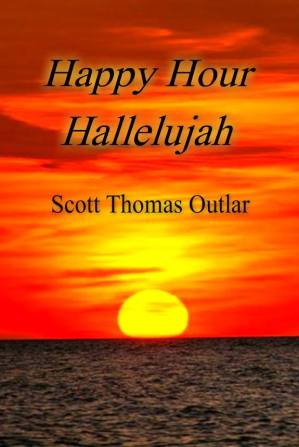
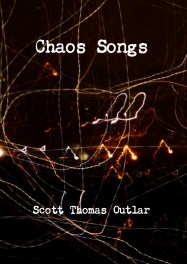 My other forthcoming book, Chaos Songs from Weasel Press, has officially been set for a September 1st release date. One day before my birthday. That’s about as cool a gift as I could possibly conceive of.



 17Numa
